Showing posts sorted by relevance for query arpeggios. Sort by date Show all posts

Saturday, July 13, 2013

Improvising with Eighth-note Arpeggios


In Lesson 35 (page 57) of John Mehgan's Jazz Improvisation and Rhythmic Principles it is suggested that "as a starting point for improvisation, abandon the melody and play the arpeggios of the chords in eighth notes." In prior lessons in Section V (p. 53) Mehegan describes arpeggios and introduces the concept of arpeggios in rhythm. In a prior post, here, I worked out similar material for jazz guitar. In this post, I'll apply the ideas to the song Sunny by Bobby Hebb.

The pdf file (here, the first few measures are displayed above) provides an example using the changes from Sunny and using Mehegan's approach starting on page 58 of  Jazz Improvisation. I have just indicated the starting string and finger to use for each arpeggio. The fingering patterns are similar to what has already been presented here with some small differences:
  • In the first measure, second line, the descending Abmaj7 arpeggio starts with the +4 fingering notation at 9B. This means that the fourth finger is raised one half step to play the root of the arpeggio, Ab. The same notation is used for the descending Abmaj7 arpeggio in the second measure, third line. The way to think about this is that all the notes of an arpeggio (to include higher order 9ths, 11ths and 13ths) are found in or around the octave. This is the reason I introduced octaves before arpeggios and block chords. It's not the only way to play a descending Abmaj7 arpeggio in two octaves (one could also start with the second finger on Ab on the high E string, that is 2 at 4e) but it retains the octave structure.
  • In the third measure of the third line, note that even though there is a jump between C of the Dm7 chord and G of the G7 chord, the two chordal arpeggios are played in the same position on the guitar. Finally, in the third measure of the first line and the first measure of the third line, the Eb13 chord, the 13th is played as a 6th (C); it could also be played as a seventh (Db) with the 13th (C) played an octave higher than the 6th.
Once you can play all the chordal arpeggios of a song in root position, Mehegan encourages you to be more exploratory: "Do not 'set' the improvised figures. Use the arpeggios both ascending and descending as well as from various inversion points (third, fifth and seventh)" (page 57). The exploration of inversions and higher order tones (9ths, 11ths and 13ths) are exercises you can develop on your own. I would suggest first learning to arpeggiate the chords in root position from memory and then going on to explore inversions and higher order tones, converting the exercise into a real improvisation. Also, explore different rhythmic combinations: half-notes, quarter notes, eight notes, sixteenth notes and 32nd notes (Matt Warnock suggests using triplets involving 3-5-7 in different orders--think in terms of the octave for the root position chord and play the 3-5-7 inversions on the appropriate string). Write out your best ideas in a notebook and use the notebook to developing your own style (John Coltrane kept such a notebook). As before, play everything in different keys.

Now that you have "heard" Mehegan's approach to developing improvisational ideas, you should remain skeptical.  The arpeggios have a particular "sound" and use within an improvisation but must be supplemented with scales, modes, block chords that can be played on guitar and non-chordal tones. All of these topics will be taken up in future posts.

In case you are still resistant to doing exercises (as I was), in the next post I will show that arpeggios are routinely used by jazz musicians. The first example I will use is the song Autumn Leaves from jazz guitarist Mike Stern's master class where Mike explains how he uses "chord turns". In a following post, I will look at the John Coltrane solo in Giant Steps where the arpeggios and rhythmic variations are particularly easy to recognize and for which we have his basic solo written out for study (please contact me if you would like a MuseScore msc file for personal study).

NOTE: If you find any errors in the pdf file, let me know.

Monday, September 9, 2013

John Coltrane: Giant Steps Arpeggios


John Coltrane was a great jazz musician, musical innovator, teacher and student (interestingly, in Philadelphia he studied with jazz guitarist Dennis Sandole). Giant Steps is one of his best known compositions and solos. It encapsulated everything he had learned up to that point in his career and included many of his enduring jazz innovations. It has been recorded by many great jazz musicians (particularly guitarists, for example, Mike Stern's solo and Pat Metheny's solo). It has been studied intensely (see a few references below) and the entire piece has been transcribed and is available (in the video above by Dan Cohen) as "animated sheet music" where the solo is linked directly to the sheet music. Finally, Coltrane's solo makes extensive use of arpeggios, the topic of my last few posts (here, here and here).

Studying Giant Steps is typically not a topic for introductory students. To even scratch the surface of Coltrane's composition, we would need to first cover the cycle of fifths, the major thirds cycle, the Coltrane Changes, modulation, block chords, Be-bop scales, modal jazz scales, chord substitutions, figured bass, II-V-I progressions and lots of jazz theory. All these topics will be covered in future posts, but that's too long to wait to introduce Giant Steps.

There are a number of approaches to soloing over the changes (see the references below), but Coltrane favored arpeggios. I will look at the John Coltrane solo on Giant Steps where the arpeggios and rhythmic variations are particularly easy to recognize and for which we have his basic solo written out for study (contact me if you would like the solo for personal study--many transcriptions on the Internet do not use the correct chord changes, see below).

What would be useful at this point is to listen carefully for the use of arpeggios in the video above and follow the animated sheet music, reading the notes as you go. I would argue that Coltrane uses arpeggios for a specific purpose in the solo, that is, to add dynamic interest (more on that in future posts). While you are reading the music, you will probably be distracted by the weird chord progressions. The sheet music is written in the key of C yet there are actually very few chords native to that key. Also, the lead sheet is written in one set of chord changes and Coltrane solos over a different set of changes. What's going on? If you find this distracting or interesting or both, read the technical note below. Otherwise, concentrate on what you are hearing and listen for the arpeggios.

What I would particularly like you to listen for are (1) the different patterns being used, for example 1-3-5-7, 5-3-1-7 etc., (2) what they sound like to your ear and (3) where do the arpeggios seem to start galloping along, propelling the solo forward. In the pdf file below I have written out the first eight measures of the solo (mouse over the image to see the floating palette and download the file--you can also find the pdf file and the MuseScore msc file here--opening the msc file in MuseScore will allow you to hear the Coltrane solo at reduced speed or listening now to the solo) and annotated the arpeggio and scale patterns being used to get you started (here).

Next, I would like you to play (or listen to here or if you download the msc file and play it in MuseScore here) the Mehegan-style (from John Mehegan's Jazz Improvisation book) arpeggio exercises written over the Giant Step solo changes (here).

It's really hard for me to imagine starting with the Mehegan-style exercise and ending up with the Coltrane solo. If you keep listening to both the Coltrane solo and the arpeggio exercise, you can start to imagine Coltrane playing this over-and-over-again until it becomes a hallucinatory or religious experience (maybe the same as repeated listening to a Bach Chorale). John Mehegan would probably argue that the point of the arpeggio exercise is to come up with "your" Giant Steps solo, not Coltrane's. But, this still begs the question of whether arpeggio exercises are the way to get there.

In future posts, I will take apart the Coltrane solo and fill in different sections with different ideas based on block chordsBe-bop scalesmodal jazz scales, and chord substitutions. In the next post, I'll start by introducing a simplified approach to root-position block chords from William Fowler's Guitar Patterns for Improvisation. Then, I'll return to Giant Steps and move the solo closer to the way I would play it.


TECHNICAL NOTE
Giant Steps is essentially a collection of V-I and II-V-I progressions modulating through three key changes (B-G-Eb). The solo can be looked at in two ways. First, the key of Eb is changed to Eb-minor and the cycle repeats or, second,  the modulation is dropped a whole step and the cycle repeats (A-F-Db)--the reasons are discussed more fully in the references.

In figured bass notation with key signatures in parentheses, the cycle is:

(B) ||: I (G) V |  I (Eb) V | I |
(G) II V | I
(Eb) V | I (B) V | I |

(Eb) II V | I | (G) II V | I | (B) II V | I | (Eb) II V | I | (B) II V :||

I have divided the notation in parts (after the third Eb) because at this point, the II-V-I progression is very clear. Matt Warnock teaches the second part of Giant Steps first because the progression is clearer (see his references below).

To understand the first seven measures, we have to understand the Coltrane Changes. John Coltrane's early career was spent with the blues-bassed Eddie Vinson Band. In figured bass, the standard twelve-bar blues progression is

||: I | IV | I | I | IV | IV| I | I |
  II | V | I | I :||

Going back to an earlier theme of mine, Coltrane became bored with the last four measures and began innovating and experimenting.

II               | II           | V        | I ||
II (bVI) V | I (III) V | I (I) V | I ||
I  (bVI) V | I (III) V | I (I) V | I ||
      m3     P4   m3  P4  m3  p4

The innovation in the third line (the Coltrane Changes) forms the first part of Giant Steps.

For the solo, the key changes are simply replaced with (A-F-Db)--this isn't always correctly annotated in Giant Step transcriptions but is correct in the video above and in the Wikifonia transcription  (here).

Coltrane studied the cycle of fifths, the major thirds cyclemodulation and II-V-I progressions intensely.  Giant Steps, in my view, is what he learned and passed on to us as the product of that intense study. In doing this, he also pushed arpeggios and chord changes to the limit of their usefulness, after which he moved on into modal jazz scales, enclosuresoutside playing (playing out of the arpeggio or scale notes) and avant-garde jazz. Through studying Giant Steps and other Coltrane pieces we benefit from his intense study.

REFERENCES

Matt Warnock
Giant Steps Subs
6 Essential Giant Steps Licks For Jazz Guitar
11 Essential Coltrane Licks
Simplifying the Coltrane Matrix: Part I
Simplifying the Coltrane Matrix: Part 2 Comping and Chord Melody
3 - 9 arpeggios
Soloing over Major II-V-I chord progressions
Jazz Guitar Chords - Coltrane II-V-I Substitutions

Dr. Ronald S. Lemos Shredding Coltrane Changes with the Basic Pentatonic Scale
Jeff Brent's Lessons Giant Steps Analysis
Giant Steps Composition (Wikipedia Page)
Dan Adler The 'Giant Steps' Progression and Cycle Diagrams
Jeff Bair Cyclic Patterns in John Coltrane's Melodic Vocabulary


BACKING TRACKS
Eric Watson plays Giant Steps with a backing track (uses octaves for the melody statement)
Chris Bieniek plays Giant Steps with a Backing Track (uses chords to build excitement in the solo)
Giant Steps (Medium Bossa)
Giant Steps Funk Backing Track
Giant Steps (In Small Steps) B. T.'s by Randy Martin Guitar (uses modal jazz scales)
Giant Steps Guitar Solo (over Absersold) by Ben Rick
Giant Steps (Coltrane) Julio Chumbinho HERRLEIN GUITAR

Wednesday, July 24, 2013

Mike Stern Master Class: Improvising on Autumn Leaves


In a few previous posts (here and here) I've claimed that jazz musicians actually use the kinds of arpeggio exercises that I have never had much use for. In this post, I will start providing the proof.

In the video above from a master class, jazz guitarist Mike Stern starts out by first arpeggiating the chords for Autumn Leaves and then takes off with a great example of jazz improvisation. Mike calls the arpeggios "chord turns" and explains how classical composers would outline chord changes in a "particularly beautiful way," for example in the Bach Corales. Jazz musicians can use chord turns for parts of solos as long as they make sure it doesn't sound like an exercise! Mike then goes on to demonstrate with the changes for Autumn Leaves.

In the pdf file (here) and the MuseScore msc file (here) I have written out an arpeggio exercise using the changes Mike was outlining. I've given the fingering for the the first note of each arpeggio in the first eight measures. In the second eight measures, Mike switches to a higher register. I've written these arpeggios out as octaves so you can either player the higher note or play the octave. In the sixth and seventh measures on the second page, Mike plays block chords (Em7, Eb7, Dm7, Db7). These are pretty standard root-position chords that many readers will be able to play. In a future post, I'll describe a very straight-forward way to play root-position chords on guitar, especially now that you are familiar with octaves and arpeggios.

Also, in a future post I'll go on to analyze Mike's solo in more detail. If you're interested, you can find a transcription of a Mike Stern Autumn Leaves solo from the Bob Berg In The Shadows CD here. Comparing the two solos is an interesting exercise in understanding the process of improvisation. One point I want to make here is that Mike knows and can arpeggiate the chord changes to Autumn Leaves by heart. So our first step is memorization! Then we go on to play arpeggios (and maybe throw in some block chords) until we are bored, at which point we move on to try different things that might interest us. In the Bob Berg transcription, Mike uses be-bop scales, side-slipping (outside playing) and guide tones (targeting)--all topics to be explored in future posts on jazz improvising.

In the next post, I will look at John Coltrane's use of arpeggios in his well known solo on Giant Steps. Hopefully, studying the Coltrane solo will provide enough proof that the greatest jazz musicians have made extensive use of arpeggios.

Wednesday, May 1, 2013

Jazz Guitar Basics: Scale-Tone Seventh Chords


Closed Form Arpeggio Chords by George Pasdirtz

In a prior post (here) I wrote out a simplified Wes Montgomery-style solo in octaves based on the C-minor scale. In my first attempt to play Sunny, forty years ago, I tried to play a harmonized version of the song and failed. I just didn't have enough background information and basic musical knowledge to do what I wanted to do. Even if I had been shown how to play the octave solo, I wouldn't have known why I was using the C-minor scale and what, if anything, it had to do with the song.

In this post, I'll start developing the necessary musical theory. I think that my guitar teacher, Roy Plumb, somehow assumed that I had received some background in musical theory, maybe playing some instrument as a child, but I hadn't. In any event, I would have been way too impatient to plow through all of this. After forty years of playing jazz guitar, I can only say to the person I was in 1970: "You need to do this".

"This" will essentially be working through the first few sections of John Mehegan's Jazz Improvisation book and translating it from piano to guitar. I strongly suggest you order the book. I am only going to provide enough to make it useable by the jazz guitarist. Part of the learning process will be to work through the rest for yourself.

The central argument in Mehegan's book is stated in the introduction to Section V Arpeggios:

The basic problem of jazz improvisation is to abandon the melody and build an improvised line on the elements of the chords in a tune...The chord elements are as follows: (1) Arpeggios; (2) Scales; (3) Chromatic tones (p. 53).

This will involve doing a lot of exercises with arpeggiosscales and chords. Mehegan argues that this is precisely what jazz musicians do and, back in 1970, I would have been skeptical. In future posts I will try to prove this argument by playing video of a Mike Stern master class where he describes how to improvise on the song Autumn Leaves and also a video analysis of John Coltrane's solo on Giant Steps (if you want to skip ahead, the videos are here and here). If you have an ear for jazz, the videos will tell you that Mehegan is right and that he accurately describes jazz played at its highest level.

The sheet music at the start of this post is divided into Figures.  This is a lot of basic, necessary background material on music theory and the briefest way to present it is by describing each Figure for you to work with yourself (you can right-click on the sheet music, "Open Image In New Window," and   print the window out for your personal study).

Figure 1. C Major Scale  Western music has evolved based on the diatonic or major scale (you can read more of that history here). In the C-major scale, there are seven distinct notes identified with consecutive letters starting with C-D-E-F-G-A-B-C. The intervals are T-T-S-T-T-T-S where T is a whole tone (two fret interval on guitar, a major second) and S is a semi-tone (one fret interval, a half step).   A to A would be the natural or relative minor with intervals T-S-T-T-S-T-T (to be discussed below).

Figure 2. Closed Form Chords in Thirds Diatonic harmony builds chords in thirds with each successive scale tone forming the lowest note, the root of the chord. The notes are described by root, 3rd, 5th and 7th. In John Mehegan's words "Chords of less than a seventh are insufficient for jazz (p. 11)". Chords that contain degrees greater than a seventh (9th, 11th and 13th) are considered complex chords, which I'll discuss in a future post. The Roman numerals under each chord (from I - VII) are called Figured Bass Notation. They are the "Abstract Truth" of music theory for the jazz musician and open up a more general understanding of chord progressions and "where chords come from" (much more about that in future posts). Songs never follow the chords in order from I-VII (to hear this, hit the "play button" at the top of the sheet music above). A common chord progression in Figured Bass might be II-V-I, for example, as an ending to a song. Figured Bass lets us abstract from Am7-G7-Cmaj7 chords and see the underlying abstract structure of the progression. It's important to note that, due to standard guitar tuning, the closed form chords in Figure 2 are generally not playable (more about that below). The chords can and should, however, be played as arpeggios.

Figure 3. Intervals John Mehegan makes the point that "No jazz musician thinks of lettered chords when he is playing; he hears interval steps based on the distance between one chord and another" (p. 8). Figure 3 shows the basic intervals of the C scale with guitar fingerings. The name of the interval is given beneath each interval and below the name is the guitar string where either the second or first finger of the left hand sounds the note. The finger used to sound the upper note of the interval is indicated by the note. The string on which to play the upper note can be found on the Fingerboard Chart (here). You are already familiar with the octave fingering (the 8th) from a prior post (here). The notes for the other intervals are found either within or above the octave. Here is your chance to start playing something that is important for understanding both music theory and improvising. A lot of interest in jazz solos is generated when you play an interval other than a 2nd (chromatic tones) or 3rd (chordal tones). Learn to hear, sing and play these intervals to let your ear tell you where to use them in a solo. For sure, be able to hear, sing and play middle C and then be able to work up to intervals from there (these are the first steps in ear training, an essential skill for jazz improvisation).

Figure 4. Interval Groups Intervals can be further classified into groups: P for perfect, S for secondary, o for diminished, + for augmented, M for major and m for minor. The interval group names are used to describe the qualities of chords (discussed in a future post).

Figure 5. C Major Scale in Two Octaves, A-string Unlike the piano where the notes are sitting in front of you (once you've located middle C) as either white or black keys, guitarists have to rely on fingering patterns and, because of the standard guitar tuning (E-A-D-G-B-E), there are different patterns at different points on the finger board.  The first step in learning the fingerboard and fingerboard patterns is to start playing scales. Figure 5 shows the C-major scale in two octaves starting at the 3rd fret of the A-string. For this scale, I've annotated not only the fret and string (second finger of the left hand on 3A, to start) but the finger to play each note on that string. When you change strings moving up the scale, for example from the A-string to the D-string, the position for the next note is shown at the appropriate fret (first finger at 2D, for example). The last fingering annotation, +4, indicates that you move the fourth finger up to get the final note, which is high D in this case.

Figure 6. C Minor Scale, A-String The fingerboard pattern for the C-minor scale should be somewhat familiar to you since you used the C-minor scale to play the octave solo for Sunny (here). However, to make things more complicated, this scale is different from the one used in Sunny. It is the Ascending Melodic Minor scale (also know as the jazz minor scale) and has only one flat (1 2 -3 4 5 6 7 8).  The scale played in Sunny is called the Natural Minor scale and has three flats (1 2 -3 4 5 -6 -7 8). There is yet another minor scale called the Harmonic Minor scale and it has two flats (1 2 -3 4 5 -6 7 8). And, to top it off, the Descending Melodic Minor scale is the same as the Natural Minor Scale. Confused yet (I'll talk about this in a future post after we've had more music theory)? To play the jazz minor scale as single notes, a different fingering pattern from the major scale is used starting with the first finger on 3A. Notice that the first G-note in the scale is annotated as -4; this means that the fourth finger is positioned one fret lower than normal. This is because we are about to make a pattern shift to having the first finger on 2G for the A-note. Extra Credit: work out the fingering for the relative minor scale (A-minor) discussed in Figure 1. Extra Extra Credit: work out the fingering for the Natural and the Harmonic minor scales in C. Play the Ascending and Descending Melodic Minor scales together. Listen to the differences.

Figure 7. Arpeggios C Scale Fingerings Within the pattern for the C-major scale, we can find patterns for arpeggiating each of the chords in the scale. In the annotation, I have just indicated the string on which to play the chord's root and the fingers to use in playing the other chordal tones. I leave it to you to find the correct string without shifting position. For reasons I will discuss below, once you learn the various finger board patterns for playing each chord, you will find it easy to simply annotate the fret, string (3A, for example) and the left-hand finger to use, 2 for example.

Figure 8. Arpeggios Octave Fingering Since you are already familiar with octaves from playing Sunny (here), thinking in terms of octaves generates some very easy finger board patterns to play and remember. Once you know the fingerboard, you can use these patterns to arpeggiate any chord at any point on the fingerboard. For now, concentrate on identifying the pattern you are playing and where the notes are located on the fingerboard; your goal is to read the notes, not to read the fingerings.

Figure 9. Ending Example I With the knowledge you've developed so far, you can play a simple improvised ending. The progression in Figured Bass notation is I-II / III-IV /V-VI-VII-I / I6. I will leave the fingering to you but first play it starting at 2A and, as extra credit, try to play it again starting at 8E with different fingering. The C6 final chord is a great jazz guitar barre chord played by pressing down multiple strings with the first and second fingers (work at this chord until you can sound all the notes cleanly as a prelude to block chord playing, to be introduced in future posts).

Figure 10. Ending Example II To confirm my initial statement that very few closed-form chords can be played on guitar, I've provided another ending example that uses two closed-form chords, D flat maj7 and C6. At the end I provide another C6 chord that can be played at 7D with an open A-string annotated with 0 (zero). Extra credit: Why can't we play all the closed form chords as block chords?

Figure 11. Name That Tune For extra credit, here's a progression that I really don't expect you to be able to identify but that I will reveal in future posts: VI / II Ix. For now, use it as a brief sight reading exercise.

Figure 12. Guitar Range There are two effective ranges for guitar depending on the type of guitar. For a classical guitar, the effective range stops at high E (or slightly above it for single notes). The electric jazz guitar with a cutaway can go all the way up to high B or slightly higher.

Figure 13. Double Octaves To round out your ability to play octaves, you can also play double octaves as Wes Montgomery does on the song Bumpin' on Sunset (starting at 1:48 in the video until about 2:50--this may well be the ONLY recorded, prolonged playing of double octaves in the history of jazz guitar and you can find the solo written out in the Wes Montgomery Jazz Guitar Method which may now be entirely out of print and unavailable).

Figure 14. C Major Scale in Two Octaves, E-string Here is the answer to the extra credit question in Figure 9. It is also important (particularly for writers and arrangers) to realize that you can play the same named note in at least two different places on the guitar. The notes are in different registers and sound different, that is, have a different colour (for example, play middle-C at 3A or 8E and listen to the difference). For this reason alone, annotation is very important. If the score isn't annotated, the guitarist will have to make some decisions about which register to play chords in and do the necessary annotation before playing.

Figure 15. C Minor Scale in Two Octaves, E-string Here is the fingering for the C-minor (jazz minor) scale. Concentrate on reading the notes and learning the pattern.

The reason that these exercises are subtitled "Creativity Through Boredom" is that the path to jazz improvisation is through the boredom of arpeggio, scale and chord exercises. The necessary path to really understanding a lead sheet such as Sunny is through playing the melody, arpeggiating the chords, trying different scales (such as the C-minor scale), playing accompaniment chords (comping) and developing chord solos. All these will be covered in more detail in future posts. But the idea is always the same: play these as exercises until you know the song by heart. The minute you start becoming bored, abandon the exercises and do something you find more interesting. At this point, you have the  necessary intimate understanding of what you're doing to start being creative. You hope that your audience also finds it interesting!

NOTE: If you find any errors in the pdf file, let me know. You can also find the .pdf file and the .msc file (for MuseScore, if you have it loaded on your machine) here.

Monday, November 11, 2013

Jazz Guitar Chord Studies: Comping and Complex Chords

The four legs, if you will, of jazz guitar playing are: (1) single-note melody lines based roughly on closed-form, arpeggio chords (covered in a prior post here), (2) single-note "blowing" lines based on modal playing (to be covered in a future post), (3) chordal accompaniment or "comping," that is playing chords behind another instrument, such as a sax, a singer or sprinkling chords within a melody line (covered in this post) and (4) fully harmonized block chord solos (to be covered in a future post). Comping chord forms do not allow for complete voice leading but you can get very close, as I will show in future posts. And, the comping chord forms can be used as a visual aid to running Charlie Christian-style single-note lines (see Jerry Hansen's excellent e-book Charlie Christian: Legends of Jazz Guitar). Since Wes Montgomery started out listening to and learning Charlie Christian solos, it may be that Wes learned the guitar fingerboard this way. In any event, you can get a long way playing jazz guitar with a three-legged stool, that is, modal playing (to be covered in a future post), comping chords and single note lines.


The two chord forms presented above (download the pdf file for reference here) are the G7-form with the root on the low E string and the C7-form with the root on the A or D string. Why can you get so far with these two simple forms? In John Mehegan's words: (1) "Chords of less than a seventh are insufficient for jazz" (p. 11), (2) "Jazz is basically a 'root position' music" (p. 41) and (3) the "sensitive tones" (9, 11, and 13) "… can bring a tonal interest lacking in the root, third, fifth and seventh" (p. 133). John Mehegan was writing about Jazz piano where the left-hand plays the root-position chords and the right-hand plays the improvised arpeggios or modal blowing lines. This isn't possible on guitar (the right hand is busy strumming and the left hand has only four fingers to work with), but the jazz guitarist can get very close to this ideal form of playing as I'll describe in future posts.

The first step in simulating the piano players left hand is to understand how to "grab" any root position chord for accompaniment (either for another instrument of for your own single-note lines). The chord forms pictured above were roughly taken from Chapter II of William Fowler's "Guitar Patterns for Improvisation" (here and here). From the two basic seventh chord forms (G7 and C7) you can derive a large number of jazz chords and provide chordal accompaniment to any jazz chart that has the correct chord symbols for the song.

The problem at this point will be to learn the basic root position chords all over the fingerboard. There are a number of great jazz exercises you will run into on the Internet. The one I like best also helps understand Giant Steps. The exercise starts in some key (I'll pick C), plays a II-V-I progression, changes the I to Im and starts the progression all over again in a key one full step lower (Bb in this case). The first set of changes would be || Dm7 G7 | Cmaj7 (Bb) | Cm7 F7 | Bbmaj7 (Ab)| etc. The entire sequence is:

||: (C) II V | I (Bb) | II V | I (Ab) | II V | I (Gb) | II V | I (E) | II V | I (D) | II V | I (C) :||

And, in twelve measures were back to the key of C again. Coltrane uses I-Im change as a transition into the Giant Steps solo (form Eb to Ebm7 and the key of Db).

In the II-V-I Exercise above (download the pdf file here and the MuseScore mscz file here), I work this set of progressions all over the fretboard using only the root position chords. I've given the fingerings and fingerboard locations. The II-V-I Exercise is based on moving the following form (derived from the graphic above, download the pdf file here) around on the fingerboard starting with the C-maj scale.


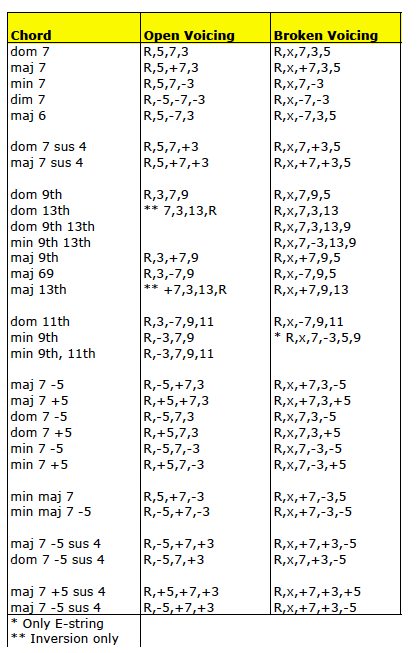
To play a four-note open voicing, skip the red dot (which just repeats the 5th). For a five-note, open voicing, just add the fifth. For the broken voicings in the chord table above, skip (x out) the lower 5th and add the upper 5th (red dot). The fingering will be different, but it will be annotated in the I-V-I Exercise when needed.

In the next few posts, I'll take the II-V-I exercise to the tunes SunnyAutumn Leaves and Giant Steps.  These chord forms will also help to understand Charlie Christian-style single note lines, chord substitutions, enclosures and playing out, so we gain a lot from learning and playing a few chord shapes. You can get a long way in jazz guitar playing with a three-legged stool, that is, single-note lines, modal playing and comping chords. In fact, you could play pretty much like Pat Martino, if you had the facility (a big "if")! On a more modest level, with the chord forms pictured above and arpeggios, you could play a jazz version of Sunny with single note improvising and octaves. You could not play a fully harmonized, block chord, Wes Montgomery style solo sitting on this three legged stool, but then neither did Wes on Sunny.

MORE DETAIL:


The basic G7 chord is played R, 5, 7, 3 whether you start on the E-string, the A-string or the D-string. Right now, let's concentrate on the locations of the root, third, fifth and seventh on the E-string, the fingering would be 1,3,1,2, for the A-string the fingering would be 1,3,1,4 and for the D-string, the fingering would be 1,3,2,4). To play Gm7 or Cm7, you would flat the third. To play either Gmaj7 or Cmaj7, you would raise the 7th.


The chord table above presents the most used forms (you can download the pdf file for reference here). For the songs we've covered so far (SunnyAutumn Leaves and Giant Steps), you should be able to find all the chords you need and, as we proceed further along, I'll layout the exact fingerings.

EXERCISES
  1. Start in the key of B-maj and write out the II-V-I Exercise, copying the C-maj II-V-I Exercise above.
  2. Experiment with the "sensitive tones". Try, for example, Bm7 - Eb13 - Abmaj7, the second and third measures of Sunny (here).
  3. Try a minor progression starting with D7sus4 - G7+ - Cm7 (measures 8 and 9 in Sunny).
  4. Identify all the II-V-I progressions in Autumn Leaves and develop exercises from these progressions.
  5. Create your own version of Giant Steps (here) using the following progression ||: (B) II V I (G) II V I (Eb) II V I  (B) II V I (G) II V I (Eb) II V I :|| and fit it into 16 measures.
  6. Find your favorite II-V-I Coltrane lines in his Giant Steps solo (here). Try playing the lines and accompanying yourself with quick II-V-I chord changes after the single-note lines.

Thursday, May 16, 2013

Developing Jazz Guitar Sight Reading Skills

In the last post (here), we started with pretty basic material covering scale-tone seventh chords and arpeggios. The angel on my shoulder says "you have to learn this stuff and there are no short cuts or tricks" while the devil on my shoulder is saying "man, this is really boring stuff, yawn". I just read a post by jazz guitarist Matt Warnock (here) that could help with the devil that just wants to start improvising.

Matt's post was about sight reading skills, how generally poor these skills are among jazz guitarists and finding interesting ways to develop these skills. For myself, I'm great with the top two and the bottom two strings, but not so good with the middle two strings. The reason is simple: I've played a lot of charts written out in the correct register for guitar (an octave higher than the standard lead sheet) and those charts largely make use of the top two strings for melody and the bottom to strings for naming the chord changes (e.g., root position G7 can be played in either 3E or 10A--I'll introduce more of this in future posts). The important point here is that we learn by doing. But what you do is important. Although being bored is also important to jazz creativity, playing obscure sight-reading exercises may be just a little too boring.

Matt's suggestion is brilliant. Get a copy of The Real Book, start on page 1 and sight read four songs a day. Don't worry about fingering technique, use fingerboard charts (here and here) when you get stuck, but just plow through this concentrating on reading the notes and playing the tune. Play everything as written without transcribing up an octave. Since you will know most of the tunes (if you don't, find them on YouTube and get familiar--this is part of learning the jazz book), you will also know when you hit a wrong note.

Another way to do this is to print and play four Wikifonia lead sheets (here) every day. When you are just starting, pick songs you have heard before. As you get better, (1) pick songs you don't know and (2) transpose songs into different keys, increasing the number of flats and sharps over time. Don't annotate the songs for fingerings. Just play and move on.

Matt suggests going on to comp the chord progressions as if you were accompanying a singer, being careful not to conflict with the singer's melody line (which you already know at this point). If you have the The Real Book (pretty much a necessity if you want to work with other jazz musicians), chord comping works great. The changes are quite accurate and sophisticated (in a future post, I'll provide a simple explanation for how to play any root position chord you might find in The Real Book). If you're using the Wikifonia lead sheets, you might run into some problems here since not all the chords are accurate (John Mehegan has a lesson on page 201 of the Jazz Improvisation book titled 'Sheet Music Conversion' which may be necessary for some Wikifonia lead sheets and I'll cover it in a future post, but we need a lot of jazz theory first).

Matt has a number of other great suggestions and I strongly recommend reading his blog entry on Jazz Guitar Sight Reading Skills. The other suggestion I would have is to write a lot of music, but more on that in a future post. For now, here's an example exercise:

Ex. 1 Download four versions of Sunny from Wikifonia (here). Use the "Transpose" button on the right side of the page and choose "+3 (3 flats)" for the first (key of E flat major),  choose "+5 (1 flat)" for the second (key of F major), choose "-5 (1 sharp)" for the third (key of G major) and finally choose "0 (-)" for the fourth (key of C major). Play the melody for each version without annotation. Play the melody in both single-note and octaves. Play each at different positions on the fingerboard (for the E-flat key signautre, try the third and the tenth fret). Then, return to a question posed in an earlier post (here): Does Wes Montgomery make any key changes in his version of Sunny (here)?

Wednesday, November 20, 2013

Sunny: Chordal Melody Statement


In a prior post (here), I laid out two basic root-position complex-comping chord forms, the G7-form on the E-string and the C7-form on the A- and the D-strings. I also gave you a II-V-I exercise to play these forms all over the guitar fingerboard. Once you've learned these two forms, you should be able to read a decent lead sheet (for example, any song in the Real Book) and play an accompaniment, that is, comp behind any instrument or singer (see Exercise 1 below). You could also play a simple vamp (repeating figure) such as the introduction to Sunny displayed above. But, could you go further and develop a chordal melody statement, that is, play the song solo?

I've developed a choral melody statement for Sunny using just the complex-comping chord forms and a fingerboard chart (download the pdf file here, the mscz file here for MuseScore, and the chord forms and fingerboard chart here). If you look at the original lead sheet (if you would like a MuseScore mscz file of the original lead sheet for personal study, please contact me), you will see that I have raised the melody a perfect octave for guitar (but otherwise made no changes to the notes), but I have changed the chord names. Some of the changes are based on functional harmonic analysis (figured bass using John Mehegan's terminology), which I will cover more fully in a future post. Other changes involve fitting the melody within the chords listed and just trying to give the song a little more jazz flavor.

As written,  the piece should be played as a slow ballad. You will get pretty bored if you play the melody as actually written. If you are a jazz musician, you will feel like you want to break out of the arrangement to make it more bluesy and to make it swing a little more. That's great! That's exactly the purpose of this exercise and of approaching every lead sheet with a lot of skepticism.

Let me go through the process of analyzing the lead sheet more slowly. The chords of the first four measures are written as:

Cm7 | Bbm7 Eb | Abmaj7 | Dm7 G |

but I have written the chordal melody statement out using

Cm7 | Bbm6 | Eb13 Bbm7 | Abmaj13 D7sus4 | G7 |

The Bbm6 chord was substituted for Bbm7 because the melody note, F, is the sixth degree of the Bbm chord. Some writers might have named this Bbm13 and, if you were following the complex chord form sheet (here), you might also choose Bbm13. To my ear, however, the chord sounds more like a Bbm6 when played against the following Eb13 and Bbm7 chords (see Exercise 6 below).

The Eb13 chord was chosen rather than Eb because the Eb major triad (Eb-G-Bb) doesn't sound right (to a jazz musician) and the melody line going from Eb to C suggests Eb13 (since C is the 13th degree above Eb). The same reasoning applies to the Abmaj7 chord which was changed to Abmaj13 since F is the 13th degree above Ab.

The Dm7 chord was changed to D7sus4 since G is the +4th degree of D. Finally, the G chord was changed to G7 since the G-major triad (G-B-D) doesn't make sense here. By "not making sense here" I mean that the G-major triad does not fit the functional harmonic analysis (the "abstract truth"):

|| (Eb/Cm) Im  (Ab) | II V | I (Eb/Cm) | II V ||

The song is in the key of Eb but based on the relative minor (VI or Im, that is, Cm7). The Abmaj7 chord is the IV of Eb but it is easier to see the II-V-I progression (from the last post, here) if we temporarily change the key to Ab. In the fourth measure, if we change the key back to Im (Eb/Cm) we can also clearly see the II-V-I turnaround. A standard jazz minor key II-V-I turnaround is typically written, for example, as D7sus4 - G7+ - Cm7. The Eb and G chords in the lead sheet were probably written this way because the writer was following the bass movement but not following the function of the chords within the song.

The next four measures just repeat the first four measures, so there is nothing new here.

The final eight measures function as the bridge. In the lead sheet, the chords are written:

|| Cm7 | Bbm7 Eb | Abmaj7 | Db | Dm7b5 | G7#9 | Cm7 | G7#9 ||

where I wrote the chord changes as

|| Cm7 | Bbm6 Eb13 | Abmaj 7 | Db9 | D7sus4 | G7 | G7+ | Cm7 | G7#9 ||

The same reasoning applies. The Eb major triad does not make sense here but Eb13 does. The Db major triad also does not make sense but Db9 does (given the second Eb melody note, the 9th degree of Db). The G7#9 chord in the lead sheet, although jazzy sounding, doesn't really sound right until the end of the bridge while the G7+ sounds better to my ear given the extended II-V-Im turnaround.

As a bonus, I've provided a two-measure vamp at the end. The reason for the bonus vamp is that, in the next post, I will start writing out the transcription for Wes Montgomery's chordal melody statement for the "alternate take" of Sunny from the California Dreaming album (here). I will try to demonstrate that the complex comping chord forms are enough to play a typical melody statement of the from Wes Montgomery liked to use. However, I'll repeat the musician Jimmy Stewart's warning that when approaching "…Wes' stylistic solos … it is advisable to first play the lead sheet form before you attempt the stylistic solo" (p. 18 in the Wes Montgomery Jazz Guitar Method).

In the next post I'll start explaining why Jimmy Stewart was dead on with this warning.

FINGERINGS

The fingerings are annotated with numbers 1-4 corresponding to the fingers of the left hand starting from the first finger opposite the thumb. The thumb is never used for "grabbing" a bass note on the E-string, although Wes Montgomery (and a lot of other guitarists) can be seen doing this on videos. The left thumb should stay firmly on the back of the guitar neck!

Barre chords are annotated by repeating the first (and sometimes the second, third and fourth) finger.

When a chord is not annotated, the fingering is the same as written earlier in the song. Single notes have  not been annotated but, at least in the song above, can be found around the chord shape and would use fingering based on the fret position of the chord (see the discussion for arpeggio fingerings here).

EXERCISES
  1. Pick any lead sheet in the Real Book and practice a chordal accompaniment (comping) using the chord forms laid out in the prior post (here).
  2. Write out a chordal melody statement for Autumn Leaves (see the prior post here).
  3. Write out a chordal melody statement for Giant Steps (see the prior post here).
  4. Pick any song in the Real Book and try to write out a chordal melody statement.
  5. Listen to Wes Montgomery's chordal melody statement for Sunny (it's the 7th cut, "alternate take" on the California Dreaming album here). Print out (download the pdf file here) and annotate areas in the chordal melody statement that differ from Wes' approach.
  6. Take a careful look at the | Bbm6 - Eb13 - Bbm7 | Abmaj 7 | II-V-I turnaround. From the perspective of a jazz improvisation, are Bbm6 - Eb13 - Bbm7 basically elements of the altered Bbm scale, especially when you go back and look at the G7 chord form shifted up to 6E? Can you find all of these chords within that chord form at the sixth fret?
  7. Start improvising: (1) combine the chordal melody statement with single note arpeggios (from work on the earlier post here) for a single-note solo, (2) combine the chordal melody statement with an octave solo (from the earlier post here), and (3) EXTRA CREDIT use the complex-chord forms to develop of chordal improvisation!


Monday, April 27, 2015

So You Want To Play Like Wes Montgomery, Part 1


This post originally started out recapping my history trying to learn jazz guitar (starting with early  Wes Montgomery recordings), only because I think I made some mistakes that I would encourage students not to make as they learn the guitar. But things have changed as explained in my last post (here). There is now a Wes Montgomery International Jazz Guitar Competition. This is only the first year for the competition. How long it will last I do not know but my hope is that it lasts for a very long time. In any event, if you enter the competition, you have to confront the Wes Montgomery jazz guitar legacy (certainly, this is one of the purposes of the competition). So, whether or not you want to play like Wes Montgomery, you will have to decide before the competition how much like Wes Montgomery (if at all) you intend to play for the submission. To do that, you have to learn something about how Wes Montgomery played. If you are an instructor teaching jazz guitar, you might have to deal with more student interest in Wes Montgomery.

Suppose a guitar student shows up (as I did forty years ago) and says "I want to play like Wes Montgomery" or "I want to enter the Wes Montgomery International Jazz Guitar Competition". What do you say to them? Is there a book you can give them? Is there an educational program you can put them on that they can complete? Is there someone you could point to who has actually done this?

First off, it might be a poorly stated goal. Did I mean I wanted to follow the steps Wes Montgomery did to learn Jazz Guitar? If so, don't read this blog, don't look for a teacher or for an instructional book, since Wes did none of these things. He started with a four string tenor guitar given to him by his older brother Monk Montgomery. He switched to a six string when he heard his first Charlie Christian record. He worked out and memorized all the Charlie Christian solos he found on records. He went out in Indianapolis clubs and played these solos note for note. He played so well he got a job with the Lionel Hampton band (Hampton worked with Christian in the Benny Goodman band and was looking for the Christian sound in his band). Wes never had a formal teacher (the best teacher in Indianapolis was all booked with students). He evidently never read instructional books (this is a little hard to believe but what the books of that era contained was pretty poor in any event). He worked everything out by brute-force saying that every guitarist has "the same six strings I do". He stumbled onto octave playing and playing with his thumb by chance. He never used his fourth finger when playing single-note lines. He played sophisticated chord voicings but struggled with the names for the chords and could not read music.

It's safe to say that today (1) no one knows exactly how Wes Montgomery learned to play jazz guitar since he did it by himself and never wrote an instructional book and (2) no one would or could ever duplicate exactly the steps Wes went though learning the instrument. However, in the words of drummer Jimmy Cobb, "He left a whole lot of stuff there for you to work on, if you're a guitar player" (Fitzgerald, 2009: 1). Unencumbered by instruction and surrounded by great musicians (Monk Montgomery, Buddy Montgomery, Mel Rhyne, the Lionel Hampton Band and more) and great music, Wes discovered new territory for the jazz guitar. In the post-Montgomery era, this new territory has been well studied (see references below).

The bigger challenge for jazz guitarists today is to understand what was discovered by Wes Montgomery and build on it. The person that succeeds at this will stand a good chance of winning the Wes Montgomery International Jazz Guitar Competition and will, at least, be a very competent jazz guitarist.

A place to start would be to see what has been written about playing in the style of Wes Montgomery. Here's a summary of topics, some of which I have already covered or will cover in future posts (references and interesting quotes below):
  1. Play With Your Thumb (tornado in classical guitar technique). If you don't think you can play fast enough or are just coping Wes Montgomery lines, listen to Jim Mullen or Emily Remler
  2. Play Octaves using jazz guitar technique or classical guitar technique (parallel octaves). See my prior post here. Also, learn to play double octaves (for example, Bumpin' on Sunset transcribed in Sokolow, 1988: 28-33).
  3. Use a fat body arch-top jazz guitar (Wes used a Gibson L-5 CES, way too expensive now--there are many other excellent reasonably priced jazz guitars, for example the Epiphone Joe Pass, the Aria Pro guitars and others).
  4. Play along with recordings. Wes memorized Charlie Christian solos from records but he also slowed down the turntable to study Giant Steps and communicated with Creed Taylor using tape recorded songs. In Wes' era, turntable or tape speeds could be slowed down to learn songs. Since we can no longer do that with digital media, consider using a free audio-editor and recorder such as Audacity and use the "Change Speed Effect" which does not change pitch while slowing the recording down. 
  5. Watch Wes Montgomery play the guitar in every video you can find (for example, Wes Montgomery Live in '65 Full Concert). Notice that Wes never gets locked into a box, he is always moving fluidly up and down the neck in response to the flow of his improvisation. Most of the improvisation is done on the top four strings, especially in the higher registers (possibly a holdover from Wes' start on the four-string tenor guitar). Compare these visuals to, for example, Pat Martino (particularly the Pat Martino Trio -- Lotus Jazz Festival 2014) who seems to work mainly on the middle four strings all over the neck.
  6. Learn the Blues (for example, Blues in F, Blue Monk, Twisted Blues, and many others). Be sure to read the excellent discussions of Missile Blues (Marhsall, 2001: 9-10), West Coast Blues (Marshall, 2001: 24), Naptown Blues (Sokolow, 1988: 70), Movin' Wes Part I (Sokolow, 1988: 55) and Movin' Wes Part II (Sokolow, 1988: 92).
  7. Learn to swing (it's hard to teach but there is a good discussion by Emily Remler here).
  8. Play Ballads (required by Wes Montgomery International Jazz Guitar Competition for example Misty, Ghost of a ChancePolka Dots and Moonbeams, Serene,  Angel Eyes and more).
  9. Play Pop Music and Smooth Jazz (The origins of Smooth Jazz have been traced to the albums by Creed Taylor and Wes Montgomery, for example the Bumpin' album).
  10. Play Bossa Nova and Latin Jazz (for example, How Insensitive, Here's That Rainy Day, Watch What Happens, Besame Mucho, Nica's Dream, and more)
  11. Play Rock (for example, Green Peppers, Goin on to Detroit, Winds of Barcelona, Wind Song, Goin Out of My Head, Windy, Eleanor Rigby, and more).
  12. Learn to "first play the lead sheet form before you attempt the stylistic solo" (Garson et. al, 1968: 18). Make sure to add bluesy touches to the lead sheet; don't play it straight. Most lead sheet melodies can be played easily within two-octave boxes choosing the position based on the key signature. The boxes extend nicely on the top four strings, showing how Wes Montgomery certainly visualized the fingerboard. If you don't have a lead sheet, play the melody along with a recording and memorize it (how Wes did it) or write out the melody and make your own lead sheet (for the chords, play the bass line and use Figured Bass--I'll talk more about this in future posts but also see Mehegan, 1959: Chapter 76). 
  13. When improvising "retain enough of the notes of the original melody to maintain the feeling of the tune"(Garson et. al, 1968: 18). Either explicitly or implicitly target the melody notes (Garson et. al, 1968: 18).
  14. Play Vamps and Ostinatos (for example, Movin' Wes Part II, Scarborough Fair, and Sunny).
  15. Use three-part structure improvisations (single-note, octaves, and chords, for example Full House). Wes did deviate from the pattern leaving out a single-note or a chordal improvisation but my guess is that he experimented with each form before deciding what worked best for the song, for example compare Sunny and Sunny (Alternate Take). In the more commercial records, the decisions were often made for him to just play octaves (Ingram, 2008: 47). 
  16. When playing single-note solos, visualize the Comping and Complex Chord shapes  of the underlying harmony as Charlie Christian did (Hansen, 2001) and Wes surely picked up through transcription.
  17. When playing scales use  sweep-picking, especially effective with the thumb (see useful closed-form arpeggio fingerings and exercises here).
  18. Learn to play chords (triads, chords built in thirds, chords built in fourths, and spread chords) and chord scales. A useful place to start is with Comping and Complex Chord shapes which are root-position chord forms widely used in jazz (you can pick up inversions later or see Fowler, 1977:5).
  19. Learn voice-leading, harmonization of non-chordal tones, treatment of appoggiatura, treatment of chordal anticipations, and  reharmonization of lead sheets (see Garson, 1968).
  20. Play every Wes Montgomery transcription (here) and Charlie Christian transcription you can get your hands on (Hansen, 2001).
  21. Listen to John Coltrane, Miles Davis, Frank Sinatra, Nat King Cole, Tony Bennett, Barney Kessel, Jimmy Raney and Tal Farlow (Ingram, 2008: 50) musicians  who Wes liked and studied.
  22. Listen to and use Big Band horn section ideas and arrangements, particularly call and response (for example,  Twisted BluesNaptown Blues,  Movin' Wes Part II, and others). 
  23. Write your own songs (possibly as a jazz contrafact). In Adrian Ingram's (2008) discography, Wes Montgomery is credited with writing forty-five songs. Start with Blues Structure, add II-V-I progressions, add Cycle of Fifths, use some unexpected chords.
This would be a lot to have to study in preparation for a guitar competition! For the current Wes Montgomery International Jazz Guitar Competition, you are going to have to be selective. One idea would be to chose the cover song you want to play, identify all the Wes Montgomery stylistic elements and bring them in to your other selections. You might also want to listen to the current submissions (here) to evaluate your competition on the Wes Montgomery stylistic elements listed above.

So far, I have posted about octaves, arpeggios, melody statements and complex comping chords. I'll try to pick up the rest of the topics over time, but I have one word of caution. We do not know definitively how Wes Montgomery approached jazz guitar playing. We know that Wes did not have a formal teacher "Wes did remember though that he once tried to get some guitar lessons for Indianapolis guitarist Alex Stevens (without success) " (Ingram, 2008: 16). We know from video recordings that his approach was somewhat idiosyncratic (he evidently did not use his fourth left-hand finger for single note playing although he did use the fourth finger for octaves on the top two strings). We know that Wes understood more musical theory than he would openly admit (he said he did not know the names of the chords he was playing but proceeded to give Pim Jacobs, here,  a sophisticated discussion of chord changes and substitutions in End of a Love Affair in the BBC sessions). Utlimately, Wes' comment that other guitarists were playing with the "same six strings I have" saves us here. We are all playing with the same six strings Wes did.

The title of this post implies that there will be future posts where I add my own insights to this list. It is also a play on the title on two great Wes Montgomery tunes Movin' Wes, Part 1 and Movin' Wes Part 2.


QUOTES

"...by the time he had reached his twentieth birthday he was playing Charlie Christian solos regularly at the 440 Club" in Columbus, Ohio" (Ingram, 2008: 12).

"I...[Wes]...even took his album 'Giant Steps' and played it at 16 rpm to study what he...[Coltrane]...was doing and every note was correct." (Ingram, 2008: 53)

"I...[Creed Taylor]...worked with the arranger, he would put a piano sketch on tape and send it to Wes  wherever he happened to be on the road.  He'd rehearse between jobs and then come into the studio to record. He didn't read at all..." (Ingram, 2008: 34).

"These few minutes in discussion with pianist Jacobs lay to rest one of the mythologies surrounding Wes and the nature of his musicianship. How often in liner notes and articles have we been dutifully reminded of Wes's supposed inability to read music, the fact that he was 'self-taught' and all of the other points of lore trotted out to somehow mystify the genius that is utterly self-evident in the legacy that is his music?"

"In a particularly illuminating exchange, we see Wes discussing the harmony with pianist Jacobs. In requesting one of his favorite variations on the tune's ...[The End of a Love Affair]... descending harmonies we hear a musician not only fluent in the traditional nomenclature of harmony, but one who is thoroughly enlightened, eloquent and direct. (Instead of Bbm7/Eb7/Abmaj7 direct to the following Abm7/db7/Gbmaj7, Wes requests that an additional II-V anticipating the next change a half step higher be added to set up the next sequence, resulting in Bbm7/Eb7/Abmaj7/Am7/D7/ the onto Abm7/Db7/Gbmaj7 etc.)" (Metheny, 2007: 7-9).


REFERENCES

(If you are aware of further references, let me know and I'll add them to the list.)

Amazon Wes Montgomery.

Pete Billlmann and Paul Pappas (nd). Wes Montgomery Guitar Anthology. Milwaukee, Wisconsin:Hall Leonard.

Dan Bowden (1995) Wes Montgomery: The Early Years. Pacific, MO: Mel Bay Publications.

Corey Christiansen (2001) Essential Jazz Lines in the style of Wes Montgomery. Pacific, MO: Mel Bay Publications.

Tim Fitzgerald (2009) 625 Alive: The Wes Montgomery BBC Performance TranscribedTim Fitzgerald Music.

William L Fowler (1977) Guitar Patterns for Improvisation. Chicago, IL: Maher Publications.

Lee Garson, Jimmy Stewart and Charles Stewart (1968) Wes Montgomery Jazz Guitar Method. New York: Robbins Music.

Ralph Gleason (1961) Wes Montgomery.

Dave Gould (2013) Wes Montgomery Interviews: Interview by Ralph J Gleason first published in Guitar Player Magazine in 1973

Dave Gould (2013) Wes Montgomery Obituaries

Jesse Gress (1998) The Godfather of Cool: Wes Montgomery's Baddest Solos Note for NoteGuitar Player Magazine.

Jess Gress (2008) 10 Things You Gotta Do to Play like Wes MontgomeryGuitar Player Magazine.

Garry Hansen (2001) (ebook) Charlie Christian - Legend of the Jazz Guitar Scrib

Jamie Holroyd (2013) Play Like Wes Montgomery Today.

Adrian Ingram (2008) Wes Montgomery. Ashley Mark Publishing.

Henry Johnson (2006) Mel Bay Presents: Wes Montgomery Best of Boss Guitar. Pacific, MO: Mel Bay Publications.

Steve Kahn (1995) The Wes Montgomery Guitar Folio. Ft. Lauderdale, FL: Gopam Enterprises.

Wolf Marshall (2001) Best of Wes Montgomery. Milwaukee, Wisconsin:Hall Leonard.

John Mehegan (1959) Jazz Improvisation. New York: Watson-Guptill.


Matt Mullenweg (2013) Wes Montgomery | Jazz Quotes

George Pasdirtz (2013) Wes Montgomery Transcriptions.

John Purse (1995) Mel Bay Presents: Wes Montgomery. Pacific, MO: Mel Bay Publications.

Emily Remler (2014) Bebop and Swing Guitar. Video and Instructional booklet.

Sheet Music Plus Wes Montgomery.

Fred Sokolow (1976) Wes Montgomery Jazz Guitar Solos. Hialeah, FL: ALMO Publications.

Fred Sokolow (1988) Wes Montgomery Artist Transcriptions for Guitar. Milwaukee, Wisconsin:Hall Leonard.

Leo Valdes (2013) Transcriptions: The Guitar Solos of Charlie Christian

Matt Wampler (2013) Wes Montgomery

Matt Warnock (2011-2014) Wes Montgomery

Matt Warnock (2011) Jazz Guitar Chords: Wes Montgomery Chord Scales

Matt Warnock (2012) Wes Montgomery Chords for Jazz Guitar -- V-I Concept

Matt Warnock (2013) 3 II-V-I Wes Octave Licks for Jazz Guitar

Matt Warnock (2013) Learn About Wes Montgomery (1925-1968).

Matt Warnock (2013) Learn About Charlie Christian (1916-1942).

Matt Warnock (2015) How to Play Jazz Guitar in the Style of Wes Montgomery. e-Book

Josh Workman (2006) The Top Five Wes Montgomery Riffs of All TimeGuitar Player Magazine.

Josh Workman (2005) "Motgomeryland Funk": As Performed by Wes MontgomeryGuitar Player Magazine