In my last post (here) I introduced the current project of Joshua Redman & Brad Mehldau. Now, let's do something with that by integrating it in our own playing. Let's take the Jazz Standard The Nearness of You, a Hoagy Carmichael song from 1938. Here's the figured bass:
A: (F) || I | Vm Ix | IV | IVo | III bIIIx | II V | III bIIIx | II V ||
|| I | Vm Ix | IV | IVo | III bIIIx | II V | I bVIIx | I6 ||
B: || II | V | I Vm | Ix | IV | IIIo VIx | II | V ||
A: || I | Vm Ix | IV | IVo | III bIIIx | II V | I (VI | II V) ||
There are lots of special (III-bIIIx or IV-IVo or I-Vm-Ix, etc.) and standard (II-V-I) chord progressions that make the song interesting. There are also parts of the song that could be altered to add interest, for example a modal Gm bridge with the bass pedal on G. And, of course, Mehldau does a lot of interesting things with chord changes throughout the song. There is much to study here.
EXERCISES
If you play a chordal instrument (guitar, vibraphone or piano), find an interested musician who plays a single note instrument (brass or string instrument), make sure you know this song in-and-out, by memory and are comfortable with it (if not, find some other song you are). Then, try a free improvisational session in the style of Joshua Redman and Brad Mehldau. How did it work for you? What did you learn? (If you don't play a chordal instrument, find a guitar, piano or vibraphone player).
Use lines from the Redman-Mehldau version, particularly Brad Mehldau's introduction, and write a new song using those ideas and any parts of the figured bass above you find interesting. Play the song for some other musicians. If you've done this exercise correctly, they should not have been able to identify your new song as The Nearness of You. If you need more inspiration, listen to Milt Jackson's version (below), one of my favorites.
The PBS NewsHour just ran a piece on Joshua Redman's new project with Brad Mehldau. This is really different from his last project with the Bad Plus in that Redman and Mehldau are emphasizing improvisation while The Bad Plus downplayed the improvisatory aspect of their playing. The NewsHour feature was a little frustrating in that they only played brief cuts of Redman and Mehldau improvising. The NewsHour feature really didn't demonstrate Redman and Mehldau's approach to improvisation which involves listening and interacting. The following cut (from SoundCloud) seems to be a good example.
As a brief comparison with Redman's earlier project, The Bad Plus Joshua Redman, try the following piece for comparison.
There is a lot more of Joshua Redman's work to hear on SoundCloud if you are interested:
It might seem at first that Jazz composition would have little to learn from Baroque Music. In an interview with National Public Radio (NPR here), mezzo-soprano Joyce DiDonato helped clarify the issue for me.
NPR was interviewing Ms. DiDonato about her new album In War and Peace: Harmony Through Music. The album is a collection of baroque arias from the 17th and 18th centuries. It is divided into two sections, the first addressing war, the second addressing peace. Two comments DiDonato made in the interview caught my attention.
First, somewhat later in the interview, she said:
There is a purity to the music of the Baroque world. We haven't hit dense harmonies yet. It's not overly complex orchestrations. It's really a chance where the text and the voice get to be center stage. And I think that's a chance for more raw emotion to emerge, because there's so much space for the listener to enter into this music.
DiDonato finds that returning to the earlier, less complex form of classical music allows more raw emotion to emerge and also allows the listener to enter more easily into the music. The same can be said for the transition to modal compositions in Jazz. A great example is Miles Davis' Kind of Blue album, one of the most successful jazz albums ever released. The compositions are modal, meaning very simple chord progressions with improvisations drawn from the actual notes in the melodies (rather than from scales and chord substitutions).
Second, was the process DiDonato used to select the arias for her album.
I was sitting at my piano going through a stack of arias, trying to find repertoire for this, and the Paris attacks had just happened. And I thought, I have to address what's happening today, because these composers from years and centuries ago have already been talking about war and peace.
There is a largely unexplored area of jazz composition where choices of songs on an album are designed to address "what's happening today". Jazz is one of the least popular form of music in the US accounting for just 1.4% of total music consumption (tied, interestingly, with classical music). Joyce DiDonato has revived interest in baroque music by, first, linking it to "what's happening today" and second, by throwing off the stuffy, fat-lady-sings image of opera singers. Jazz musicians take note!
Here is the entire NPR inter interview:
EXERCISES
Pick a current "what's happening today" topic that interests you and that you care deeply about (forget about your love life or the typical topics that are the basis for Rock, R&B and Blues songs). If you don't have any concern about "what's happening today," get concerned!
Go through your jazz collection, the Great American Song Book and the Real Book (your stack of arias) looking for songs that speak to your "what's happening today" concern. It helps if the songs have lyrics and if you know the lyrics. Maybe the song title is corny or dated, but there might be a lyric that speaks to your issue.
Now comes the fun part! Rewrite the song. Change the title: uses some lyrics you like or some phrase that's appropriate to your concern. Simplify the chord progression by looking for the few chords that capture the feeling you are after. Simplify or entirely change the melody so that it fits a modal scale you find particularly interesting and appropriate to the new song. For the solo, improvised sections of the song, pick one or two chords and use the modal scale (not the original chord changes) for improvisation. Next, change the rhythm of the song: turn a swing song into a ballad; turn a ballad into a Bossa Nova; turn a rock song into Latin Beat; turn a blues song into a Hip Hop beat. Pick some rhythm from modern dance music. Forget standard jazz rhythms.
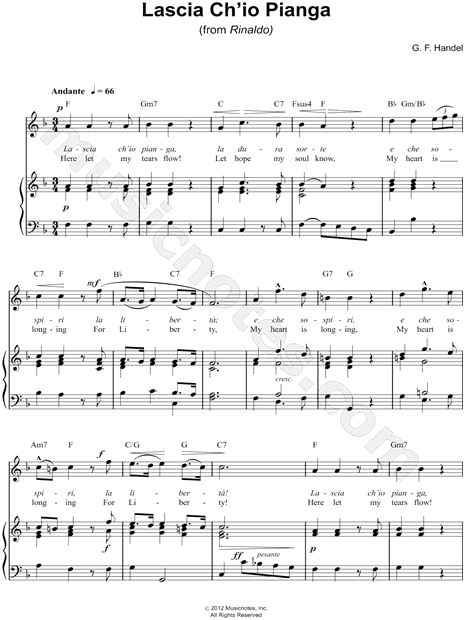
EXTRA CREDIT: Go right to the source. Take the Handel aria Joyce DiDonato sings in the video above (guitar score here, entire aria here, chord progression and melody here) and rewrite it as a modal jazz head (see the figured bass line below).
Why should you bother doing any of this? Here's another quote from Joyce DiDonato:
Music can be a real guiding light towards empathy, and I can't think of any better prescription. Let's put it to the United States of America right now, a country divided. If we had more empathy, that's a healing thing. And music, because it goes to the heart and bypasses the brain, can put people in a position to hear another point of view, to be less afraid of it. I believe a thousand percent that music can do that and this album can help that. I would love for that to be true.
FIGURE BASS
Lascia ch'io piangaAn interesting aspect of this Handel aria is that it was used in a number of operas under different names and slight rearrangements.
(F) || I | II |V | Ix I | IV | V I | IV V | I ||
(G) || I | V I | II (F) I | (C) V | I (I) | I ||
Notice the key changes (in parentheses) and the six measure bridge. Use the lyrics to name the new song:
Lascia ch'io pianga mia cruda sorte, e che sospiri la libertà.
Il duolo infranga queste ritorte de' miei martiri sol per pietà.
Allow that I weep over
my cruel fate,
and that I may sigh
for the freedom
Let my sadness shatter
these chains
of my suffering,
if only out of pity.
I am not a critic and don't write reviews of other musician's work, so technically this post is not a review. But, I just can't help commenting on this album.
If you are a jazz musician, you have to hear this album. It features Kitty LaRoar (vocals), Nick Shankland (piano) and Ed Jones (sax). No drummer. No bass player. I listen to a lot of music but I can't say that I have ever heard an album like this before (you can tell me in the comments if you have). But, I have experienced the feel of this album one time before. It was at the end of a long engagement. The last set. The last song. It was late. The bar was empty except for a small audience, all sitting apart at different tables. It was the last time this group would ever play together. They were all exhausted.
Somehow, the players all managed to dig in and give one final quiet, beautiful last performance of their standard ending tune. The playing was quiet, intense, not an extra note played anywhere, just the distilled essence of a year working together. A peak experience for everyone. No one talked as the group packed up and went home.
This, I have found, is what jazz musicians play for, night after night in rooms with poor acoustics, inattentive audiences, misbehaving equipment and rude club owners. It's that one peak experience. It has only happened to me once.
What is so unusual about "Valentine's Eve" is that every song feels like, and takes me back to, that one night a long time ago in a club I can't remember. I wrote Nick Shankland that, at first I could taste my martini and smell the smoke. After listening to the entire album, it was much more than that. If you are a musician and have never had that peak experience, the only way I could possibly tell you about it is to have you listen to this album. The musicians in the group I played with have never talked with me about that last set. We probably would not know what to say to each other.
The trailer above will give you brief sample. If you like it and get just a little transported or are just a little interest in what a peak playing experience feels like, by all means buy the entire album. Just remember, this is not a review. I'm not a critic and don't write reviews.
P.S. If you are a musician, please pay close attention to the sections where voice, sax and some times piano work in unison. This is not easy. It's especially difficult to play quietly, maintain your intensity and maintain your pitch. I never lost my attention for one minute while listening to this album and I am the most easily distracted person the universe.
The PBS NewsHour ran another great piece by Rob Kapilow titled A contemporary composer considers the musical legacy of Johannes Brahms. The piece might easily be overlooked by a jazz musician but that would be a mistake. Kapilow explains how Brahms was able to write from the "heart" with "mathematical precision". Surely, this is the challenge for every composer and improviser.
The device Brahms used in this piece is what Kapilow calls "1, 2, up" and then "1, 2, leap" and then resolving to "1, 2, down". Here is the first four measures of the Brahms Intermezzo in A Major, Op. 118, No. 2
You can listen to Arthur Rubinstein play the entire piece here (if you just let YouTube play you will hear different versions and even, possibly a Bill Evans piece--Listen). It is a beautiful, emotional piece of music built on a simple concept.
EXERCISE
1. Use the "1, 2, up, leap and down" device to write a simple modal piece in Am or a Im-IVm-V+ progression for eight measures or any chords in the key of Am. Concentrate on the melody (remember from my last post that the chords are arbitrary).
2. Next switch from Am to A major and continue with the modal piece or the I-IV-V structure.
3. Then start the keys descending from A-Gm-Fm-F-Ebm.
4. Do it all over again, this time looking for other lines around which entire new compositions can be built.
Today is Wolfgang Amadeus Mozart's birthday. Yesterday, the PBS News Hour (here) ran a piece with composer Rob Capilow discussing Mozart's Symphony #40 in Gm (video above), one of his most well know works (you can hear the entire symphony here). In the symphony, Mozart takes a simple three-note idea and develops it into a major work relying only on his great creative powers. This is the essential challenge facing any jazz musician and the symphony is worth any creative musician's careful study.
Here's the opening theme which every musician will instantly recognize (you have probably heard it on someones cell phone ringtone here, the musical notation is from Wikipedia here).
Through key changes, chord changes, rhythm changes, pure invention, and creative genius, Mozart turns it into a masterpiece. Happy birthday, Wolfgang Amadeus Mozart, an inspiration to every creative musician.
EXERCISE
1. Take any simple jazz, blues or folk melody. Using key changes, chord changes, rhythm changes and your own creative powers, transform it into a jazz masterpiece!
The twitter posting above from the great Jazz Guitarist Russell Malone summarizes pretty much how I have always felt about competitions. For me, it's like going to Las Vegas and gambling. I know I'm going to loose. What's the point?
Now that I'm older and not eligible to enter the Competition (see the rules here), I have a little different perspective and I would give different advice to myself. Even if you're not going to win, if you had a point you were trying to make, your reason for going through all the trouble would be to make the point. Looking through a lot of the submissions (actually the only person I know who listened to all the submissions was George Klabin, president and founder of Resonance Records--I wasn't even in the top ten with 72 views), my impression is that none of the guitarists actually used Wes Montgomery's three-tier approach to improvisation (single note, octaves and chords) or many other aspects of Montgomery's playing (see my discussion of Wes Montgomery's approach here).
One strategy you might adopt as a contestant would be to actually apply Wes Montgomery's approach to your submission. For me, at least, the main purpose of the competition should be to keep Wes Montgomery's music and vision alive. Unfortunately, the stated purpose of the competition was to "find the generation's next great jazz guitarist," which I think is a mistake. No competition will discover this person for the jazz audience. A submission that really kept Montgomery's vision alive (and maybe even extended it a little, if that's possible) would at least have to make the judges pause for a moment.
Maybe great facility and fast playing always win competitions but those were never Montgomery's goals. And, maybe Wes would have never won a competition or even bothered submitting (he had to be pushed to originally audition for Lionel Hampton). He was far too modest and self-effacing. I think that is Russell Malone's point and I completely agree. But, there is still a part of me that likes to make a point, particularly through my playing.
In future posts I'll try to lay the ground work for keeping Montgomery's vision alive.